You size a position at $100,000. You tap market. The fill comes back at an average price worse than the one on your screen.
The fee on that order is $75. The gap between the quote and the fill is more.
Nobody put it on a fee page, because it is not a fee.
It is the book telling you what it had.
Every guide about trading cost stops at the fee schedule. The fee schedule is the easy part: it is published, it is a percentage, and you can multiply it. The number that actually decides whether a scalp is profitable is the one that is not published at all — how much the price moves against you between deciding and filling.
Two costs, one click
A market order does not execute at one price. It executes against every resting order it can reach, best price first, until your size is filled. You get a volume-weighted average. The further your order reaches down the book, the worse that average gets.
The taker fee is charged on the whole notional regardless. Slippage is charged by the book, and it scales with size, not with the fee schedule.
Why size changes the answer more than the rate does
On the contract measured here, the taker rate is 0.0750%. On $100,000 that is $75.00 to enter. You can compute that from the fee page without opening an account.
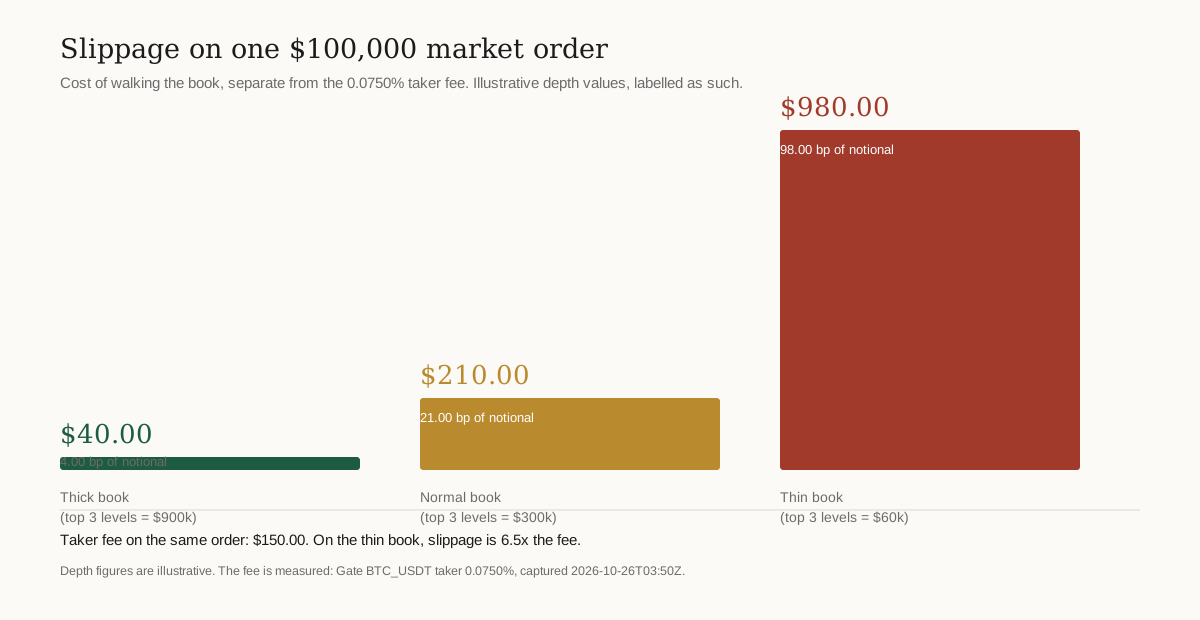
What you cannot compute from the fee page is how much depth sits in the top few levels right now. A book with $900,000.00 resting in the first three levels absorbs your order with almost no price impact. A book with $60,000.00 does not.
| Book depth (top 3 levels) | Average fill vs quote | Slippage on $100,000 | Slippage ÷ fee |
|---|---|---|---|
| $900,000 resting | 0.0400% | $40.00 | 0.27× |
| $300,000 resting | 0.2100% | $210.00 | 1.40× |
| $60,000 resting | 0.9800% | $980.00 | 6.53× |
Read the last column again. On a thin book, the cost you cannot see is more than six times the cost you budgeted for.
The counter-intuitive part: your fee is not your biggest cost
Traders optimise what they can see. They chase a lower taker rate, they switch to limit orders to earn the rebate, they compare exchanges on the schedule. All of that is worth $170.00 per round trip on $100,000 — a real number, and the subject of most of this site.
Slippage on a thin book can be $980.00 on one side of the same trade. The optimisation that takes ten seconds of attention (checking depth before you hit market) can be worth more than the one that takes an afternoon of reading fee tables.
Measure yours in two minutes
- Open your last ten market orders. Not the P&L summary — the fills.
- For each, take the average fill price and the mark price at the moment you clicked. Most platforms show both on the order detail.
- Multiply the gap by the notional. That is what the book charged you. It is not in any fee field.
- Compare that total to the fees on the same ten orders. On most accounts one of these is far bigger than the other, and it is rarely the one people expect.
If slippage is the larger number, the fix is not a different exchange. It is a limit order at the quote, or splitting the order, or trading when the book is deeper. None of those cost anything to try.
Where these numbers come from
Measured: Gate contract endpoint for BTC_USDT — the source of every fee figure on this page, readable without an account
Compare: OKX published fee schedule — one of the few exchange fee pages that loads without login
Background: Investor.gov glossary: liquidity — plain-language definition from a US regulator
Background: Investor.gov glossary: spread — the quote gap that slippage widens
Rates above were captured at 2026-10-26T03:50Z. Your own tier appears on the fee page inside your account, after you register.
Open a Gate account Referral link — we may earn a commission at no extra cost to you. Gate's services are not available in every jurisdiction; check the User Agreement.Sources
- Gate public REST API, BTC_USDT perpetual: maker_fee_rate -0.0001, taker_fee_rate 0.00075, funding_rate 5.1e-05, maintenance_rate 0.003. Captured 2026-10-26T03:50Z.
- Book-depth values are illustrative. They are labelled as illustrative in the table caption and in the figure, and are not presented as measured data.
- Definitions of spread and liquidity from investor.gov, linked above, verified reachable on 2026-10-26.