Your withdrawal has said processing for six hours.
You open a support ticket. They tell you to wait.
You wait. It still says processing.
Here is what that word is actually covering — four different stages, and only two of them are the platform's fault.
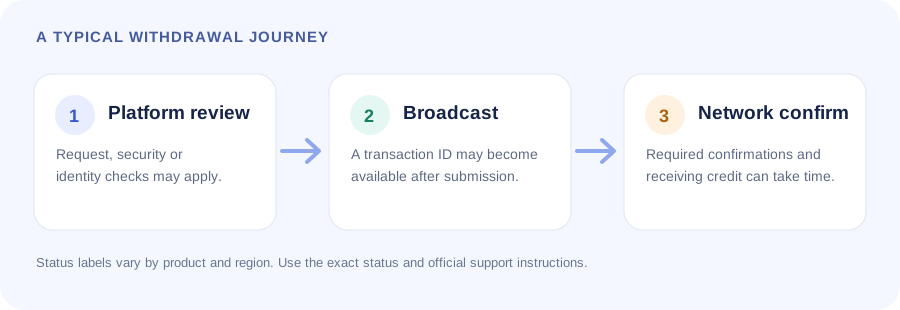
“Processing” is one label for a pipeline with four stages, and the label never changes across any of them. That is why the status page is useless when something goes wrong: the thing you need to know is which stage, and the interface does not say.
| Stage | Who controls it | What you can do |
|---|---|---|
| 1. Platform review | The platform | Nothing. This is a risk check. Usually minutes, sometimes longer. |
| 2. Broadcast to the network | The platform | Nothing. If this is stuck, support is the only route. |
| 3. Block confirmation | The network | Nothing. You can watch it yourself with the transaction ID. |
| 4. Credited by the destination | The receiving service | Nothing, but you can chase the destination with the ID. |
The one thing that tells you the truth
The transaction ID — sometimes called a hash or TxID — is issued the moment the withdrawal is broadcast. From that point the blockchain explorer is the authoritative source, not the exchange's status page.
If you have a TxID, the platform's work is done. What you are waiting for is the network and the destination. If you do not have a TxID after a few hours, the withdrawal has not been broadcast yet, and that is a platform-side issue worth escalating.
Why stage 3 takes longer than the charts say
Estimated confirmation times assume the fee you paid buys a normal-priority transaction. Two things break that assumption: network congestion, and a withdrawal fee set to the slowest tier.
A lower withdrawal fee is not free money. It buys less block space, and on a congested network that can mean hours instead of minutes. It is the one place in crypto where paying more genuinely buys speed, because you are bidding for block space rather than paying a platform.
What to do if it never arrives
- Find the TxID in the withdrawal record. Screenshot it.
- Search it on a block explorer for that specific chain. Not a general search — the correct explorer for the network.
- If it shows confirmed, the problem is at the destination. Contact them with the TxID.
- If it shows pending, the network is working on it. Nothing to do but wait.
- If it does not exist, it was never broadcast. Open one support ticket with the withdrawal reference and the time, and do not open five.
The two mistakes that cost people money
Wrong network. Sending USDT on one chain to an address on another is the most common irreversible loss in crypto. The funds exist, they are on a chain the destination does not watch, and recovery is usually impossible or expensive. Check the network name, not just the coin name.
Wrong memo or tag. Some chains require a destination tag alongside the address. Omitting it can mean the funds arrive at the destination's master wallet with no way to attribute them to you. If the destination shows a tag, it is not optional.
Both of these look identical to a slow withdrawal from the user's side: no credit, no error. The difference is that one resolves with patience and the other does not.
Withdrawal fees and minimums are shown per coin and per network inside the account, before you confirm anything.
Open a Gate account Referral link — we may earn a commission at no extra cost to you. Gate's services are not available in every jurisdiction; check the User Agreement.Sources
- Platform withdrawal flows and status labels, observed directly. Live network conditions behind those labels: .
- Public block explorer documentation for confirmation behaviour. Live gas and confirmation conditions: .
- Gate risk disclosure on irreversible transactions.
Questions people actually ask
How long should a withdrawal take?
Platform review is usually minutes. Network confirmation depends on the chain and on the fee tier you paid. If there is no transaction ID after a few hours, the withdrawal has not been broadcast.
Does a lower withdrawal fee save money?
It saves the fee and costs time. On a congested network a low-fee transaction can wait hours. You are bidding for block space, so paying more genuinely buys speed.
I sent to the wrong network. Can it be recovered?
Usually not. The funds exist on a chain the destination does not watch. Recovery, where possible at all, requires the destination's cooperation and is often expensive. Check the network before confirming, every time.
What is a memo or destination tag?
An extra identifier some chains require so the destination can attribute a deposit to your account. If the deposit page shows one, omitting it can leave funds unattributed and hard to recover.