You open a position on Monday. You check it Friday. The price has not moved.
Your account is $61.20 lighter.
You did not trade. You did not get liquidated. Nothing happened at all.
And it still cost you money, because you were holding.
Funding is the charge nobody puts on a landing page. It is not in the fee schedule in the way trading fees are. It does not appear in the order preview. And on a perpetual contract it is deducted every 8 hours for as long as the position exists, in profit or in loss.
What funding actually is
A perpetual future has no expiry date. Nothing forces its price back to spot. So the exchange creates a periodic payment between longs and shorts, sized to keep the contract anchored near the index price.
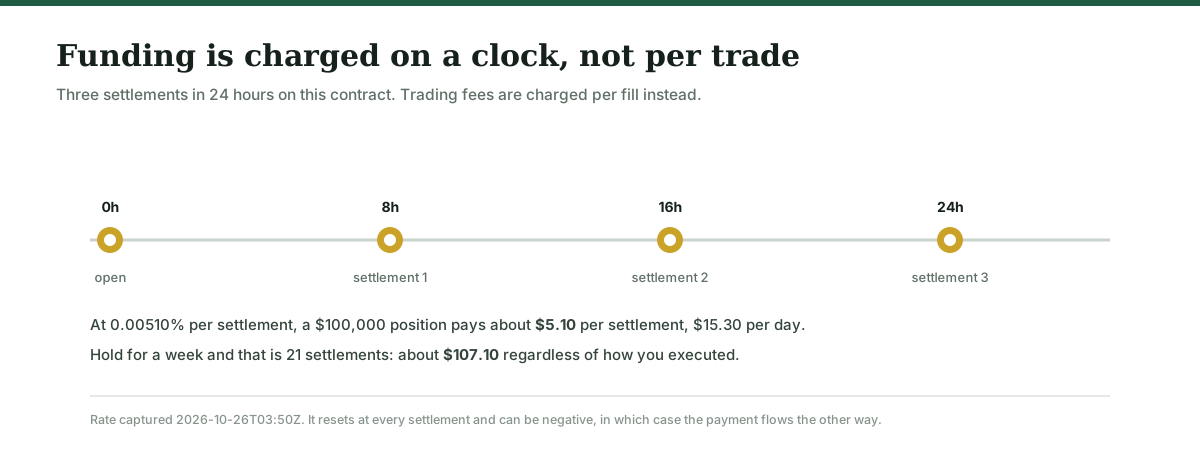
When the rate is positive, longs pay shorts. When it is negative, shorts pay longs. On the contract measured here it was 0.00510% per settlement, positive, every 8 hours — which is three times a day.
| Holding period | Settlements | Cost on $100,000 |
|---|---|---|
| 1 day | 3 | $15.30 |
| 1 week | 21 | $107.10 |
| 1 month | ~90 | $459.00 |
| One overnight hold | 1 | $5.10 |
The part that reverses your intuition
Most people assume holding longer is cheaper than trading often. On the fee side that is true: one round trip has two fills, ten round trips have twenty. But funding runs the opposite way. It charges you for time.
A position held a week paid $107.10 in funding on this contract. The same position opened and closed with market orders paid $150.00 in trading fees. Holding for a week cost more than 71% of what a round trip did — for doing absolutely nothing.
How to know which one is eating you
- Count your round trips last month. Multiply by two — that is your fill count.
- Multiply that by your notional × your taker rate. That is your trading cost.
- Count your holding days. Multiply by the settlements per day (4 on a 6-hour schedule, 3 on 8-hour, 1 on 24-hour).
- Multiply that by notional × the current funding rate. That is your funding cost.
- Whichever number is larger tells you what kind of trader you are, and which one to attack first.
Do this once with your real numbers and the answer is usually a surprise in one direction or the other. Very few people pay attention to both.
Rates and funding captured at 2026-10-26T03:50Z. Your account's funding history is the only authoritative record of what you actually paid.
Open a Gate account Referral link — we may earn a commission at no extra cost to you. Gate's services are not available in every jurisdiction; check the User Agreement.Sources
- Gate public REST API, BTC_USDT perpetual: funding_rate, funding_interval. Captured 2026-10-26T03:50Z.
- Gate perpetual contract funding documentation. The raw funding_rate and funding_interval fields are readable without an account: . Spot price used for the notional reference: .
- Gate risk disclosure section 14 (fees and funding rates may change without notice).
Questions people actually ask
Is funding a fee the exchange keeps?
No. Funding is transferred between traders: longs pay shorts when the rate is positive. The exchange does not collect it, which is why it does not appear in the trading fee schedule.
Can funding work in my favour?
Yes. When the rate is negative the payment flows the other way and a short pays you. The sign is not fixed — it was positive at 0.00510% when captured here, but it resets every 8 hours.
Is funding charged on margin or on notional?
On notional. That is why it scales with leverage: $10,000 at 10× is $15.30 a day, and at 1× it is $1.53 for the same capital.
Does closing and reopening avoid funding?
Partly, but you pay two trading fees to do it. On this contract that is $150 in fees to avoid $15.30 in funding, which is worse in every case where the rate stays near its captured level.