You withdraw $50 of a token. The confirmation says the fee is 1.2 tokens.
At the price on your screen, that is $3.40. The network charged eight cents.
The rest did not go to a miner. It went to a line item.
There is nothing hidden about it. It is simply not in the place you looked.
Withdrawal fees are the least comparable number in crypto. Trading fees are percentages of a known notional; you can put two exchanges side by side. Withdrawal fees are flat amounts per network, they differ by coin and by chain, and they are repriced whenever the chain gets busy.
That makes them the fee line where a comparison article is most likely to be wrong, and where checking your own account is most likely to change your mind.
Two costs wearing one label
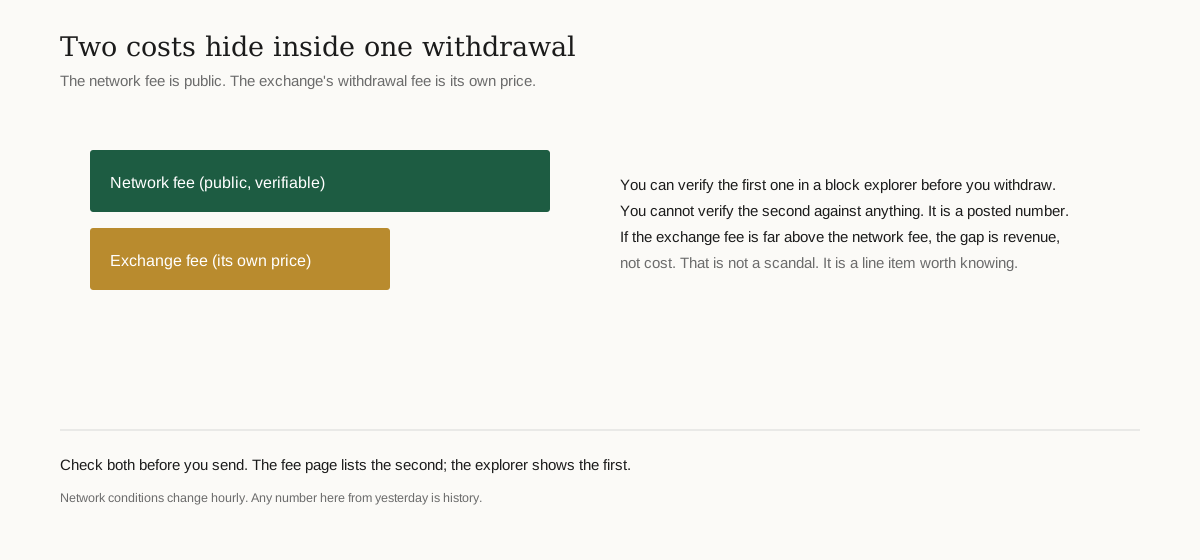
A withdrawal has a network fee and an exchange fee. The network fee is what the chain charges to include your transaction. It is public: every explorer shows it for every confirmed transfer. The exchange fee is what the platform charges you to send it, and it is its own posted price.
When the exchange fee is close to the network fee, the platform is passing through cost. When it is far above, the difference is revenue. Neither is dishonest — but only one of them changes when the chain is congested, and that tells you which is which.
The check that takes a minute
Before you withdraw, open the platform's fee page and find the withdrawal row for your coin and network. Then open a block explorer and look at the current network fee for the same kind of transfer. Write both down.
| What you are looking at | Where it lives | Does it change hourly? | Can you verify it? |
|---|---|---|---|
| Network fee | Block explorer, public mempool | Yes, sharply | Yes, before you send |
| Exchange withdrawal fee | Platform fee page, per coin and network | Sometimes, on a schedule | Only against the explorer |
| Trading fee | Fee schedule, percentage of notional | Rarely, by tier | Yes, from your own fills |
| Funding | Contract page, per settlement | Every settlement | Yes, in your statement |
If the exchange fee is many times the network fee and has not moved in months while the chain has been quiet and busy, it is a price, not a pass-through. That is fine. It just means it belongs in your cost model as a fixed cost per withdrawal, not as a variable one.
The counter-intuitive bit: withdrawal fees punish small accounts
A flat fee is a percentage that depends entirely on your size. $3.40 to move $50.00 is 6.8%. The same fee to move $5,000.00 is 0.07%.
This is the one cost where being small is expensive in a way no trading fee tier can fix. A trader moving $200 out weekly pays a higher effective rate than a fund moving $200,000 once, on the same platform, at the same taker rate.
Do this before your next withdrawal
- Look up the network fee first on a public explorer. It is the only figure not under the platform's control.
- Read the withdrawal fee row for the exact coin and network. Not the coin, the network — the same token can have a dozen.
- Divide the fee by the amount you are sending. If that percentage is larger than the trading fee on the position, the exit costs more than the trade.
- Consider batching. Two withdrawals next week cost twice what one costs today, because the fee is flat.
This is also the fee most likely to be wrong in any third-party comparison table you read, including this site's. Which is why this page does not print a withdrawal fee number: the honest answer is that it depends on the coin, the network and the hour, and you can read it in ten seconds inside your own account.
Where these numbers come from
Verify a transfer: CoinGecko: bitcoin price and chain data — price context for converting a token fee into dollars
Compare listings: CoinMarketCap: bitcoin — contract addresses and network options per token
Measured: Gate contract endpoint — the source of every trading fee on this page
Fees differ by tier and by region. The fee page inside an account is the only version that applies to you.
Open a Gate account Referral link — we may earn a commission at no extra cost to you. Gate's services are not available in every jurisdiction; check the User Agreement.Sources
- Gate public REST API, BTC_USDT perpetual: taker_fee_rate 0.00075, maker_fee_rate -0.0001. Captured 2026-10-26T03:50Z.
- Withdrawal fee structure described from platform behaviour, not from a captured number. No withdrawal fee value is asserted as current.
- Network fee verification method: public block explorer, linked above, verified reachable 2026-10-26.