The funding line on your statement reads 0.00510%.
That is five thousandths of one percent, charged once every eight hours.
It looks like a rounding error. It is 5.58% a year, charged on the full notional.
The smallest number on the page is the one that compounds.
Funding is the only cost on a perpetual that is not a transaction. You are not charged for doing something; you are charged for still being there at the settlement. Which means the cost of holding a position is a rate multiplied by time, and time is the one input nobody puts in a spreadsheet.
A rate and its repeat count
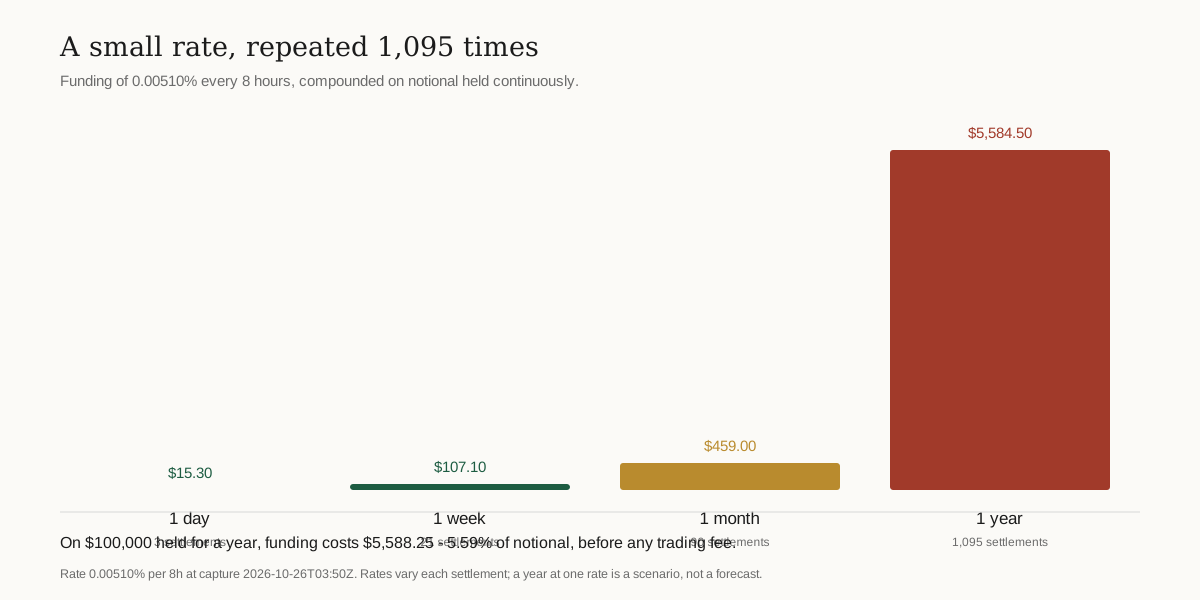
On this contract funding settles every 8 hours, so a day contains three settlements, a week twenty-one, a month ninety, a year one thousand and ninety-five. The captured rate is 0.00510% per settlement. Held constant, that is a yearly charge of 5.58% of notional.
| Holding period | Settlements | Cost on $100,000 | What it equals |
|---|---|---|---|
| One settlement | 1 | $5.10 | A coffee |
| One day | 3 | $15.30 | A taker fee and a half |
| One week | 21 | $107.10 | More than a maker round trip |
| One month | 90 | $459.00 | Three taker round trips |
| One year | 1,095 | $5,584.50 | 2.8% of the entire position |
Two numbers in that table are worth sitting with. A month of funding on $100,000.00 is $459.00, which is three times what a taker round trip costs. And a year of it is $5,584.50, roughly 2.8% of the position — larger than the entire fee schedule anyone compares exchanges over.
The counter-intuitive part: funding rewards the trade nobody makes
Every other cost in this series punishes activity. Taker fees punish impatience, slippage punishes size, withdrawal fees punish moving money. Funding punishes
Consider a trader who opens a position, holds it for a month, and closes it with a gain of 2%. On $100,000.00 that is $2,000.00. If both sides were market orders, fees take $150.00 and a month of funding takes $459.00. $609.00 of a $2,000.00 gain, and the majority of it is not a trading cost at all.
Now the same trader, using limit orders and closing inside four days: $20.00 in fees and $61.20 in funding, total $81.20. The market view did not change. The holding period did, and it moved $527.80.
When it runs the other way
Funding is a transfer between longs and shorts, not a payment to the platform. When the rate is positive, longs pay shorts. Rates go negative regularly, and then a long position is credited instead of charged. The 5.58% figure is what this rate does if it persists, in one direction, for a year.
It does not persist. It is recalculated at every settlement from the difference between the perpetual and the index, so a stretched market can pay far more than this and a flat one can pay near nothing. That variability is why the annual figure is a ceiling to plan against rather than a forecast.
Two minutes: your break-even holding period
- Find the funding rate for your contract in the API response or the platform's funding page, and the settlement interval.
- Multiply the rate by the notional and by the number of settlements per day. That is your daily carry.
- Divide your expected gain on the position by that daily carry. The result is how many days you can hold before funding eats the whole trade.
- If that number is shorter than your thesis needs, the position is too large or the product is wrong. Not the market's fault.
At this rate on $100,000.00, a trade expecting $2,000.00 of gain can be held for 131 days before funding alone consumes it. That is the number to write next to the entry price, and it changes nothing about the direction you think the market is going.
Where these numbers come from
Measured: Gate contract endpoint — funding_rate and funding_interval, the two inputs to every figure here
Second exchange: MEXC contract detail — whose funding field is not public — which is why no MEXC funding figure appears here
Background: Investor.gov: leverage — why a carried position is a borrowed position
Funding rates change every settlement. Confirm the current rate before planning a holding period.
Open a Gate account Referral link — we may earn a commission at no extra cost to you. Gate's services are not available in every jurisdiction; check the User Agreement.Sources
- Gate public REST API, BTC_USDT perpetual: funding_rate 5.1e-05, funding_interval 8 hours. Captured 2026-10-26T03:50Z.
- Annualisation is simple multiplication (rate × 1,095 settlements), matching how the platform quotes the rate. It is not a compounded yield and is not presented as one.
- The statement that funding is a transfer between position holders rather than platform revenue follows published perpetual contract mechanics.