“Is Gate safe?” is one question with four different answers inside it.
Whether your money can be withdrawn is one. Whether the company is solvent is another.
Whether it is legal where you live is a third, and whether your account stays secure is a fourth.
Three of the four have answers you can find yourself. The fourth has no public answer at all.
Bundling them produces the useless answer “it depends”. Separating them produces four questions that each have a real answer, or at least a real status.
| The question inside the question | Who can answer it | What you can actually do |
|---|---|---|
| Can I get my money out? | You, by testing it | Withdraw a small amount early. That is the only real test. |
| Is the company solvent? | Nobody, from outside | Assume self-reported. Size positions accordingly. |
| Is it legal where I live? | The platform's agreement | Read the restricted-location list. It is explicit. |
| Is my account secure? | Mostly you | 2FA, withdrawal whitelist, most funds off-platform. |
The only safety test that means anything
Every claim about reliability is a claim until you have withdrawn. The useful test costs nothing but a fee: deposit a small amount early, withdraw it, and see how long it takes and whether anything asks you to deposit more first.
A platform that processes a small withdrawal cleanly in the first week is telling you something a rating cannot. A platform that requires escalating deposits before your first withdrawal has also told you something.
On solvency, plainly
No outside party can verify a crypto exchange's full balance sheet from public information. Proof-of-reserves can show assets held; it does not show liabilities owed. A reserve ratio computed one way can look healthy and be misleading under another.
This is not specific to Gate. It is true of the whole category, which is why the practical conclusion is about position sizing rather than about choosing a platform: keep on an exchange only what you are willing to have frozen.
On legality, which is the one with a written answer
Availability is documented. Gate's User Agreement lists restricted jurisdictions explicitly, and the risk disclosure states that promotional activity is not directed at those locations. If you are in one, an account may be opened and later restricted — which combines the two worst outcomes: funds inaccessible and no recourse.
This is the question a review score never addresses and the one that most often decides whether the other three matter at all.
The controls that are actually yours
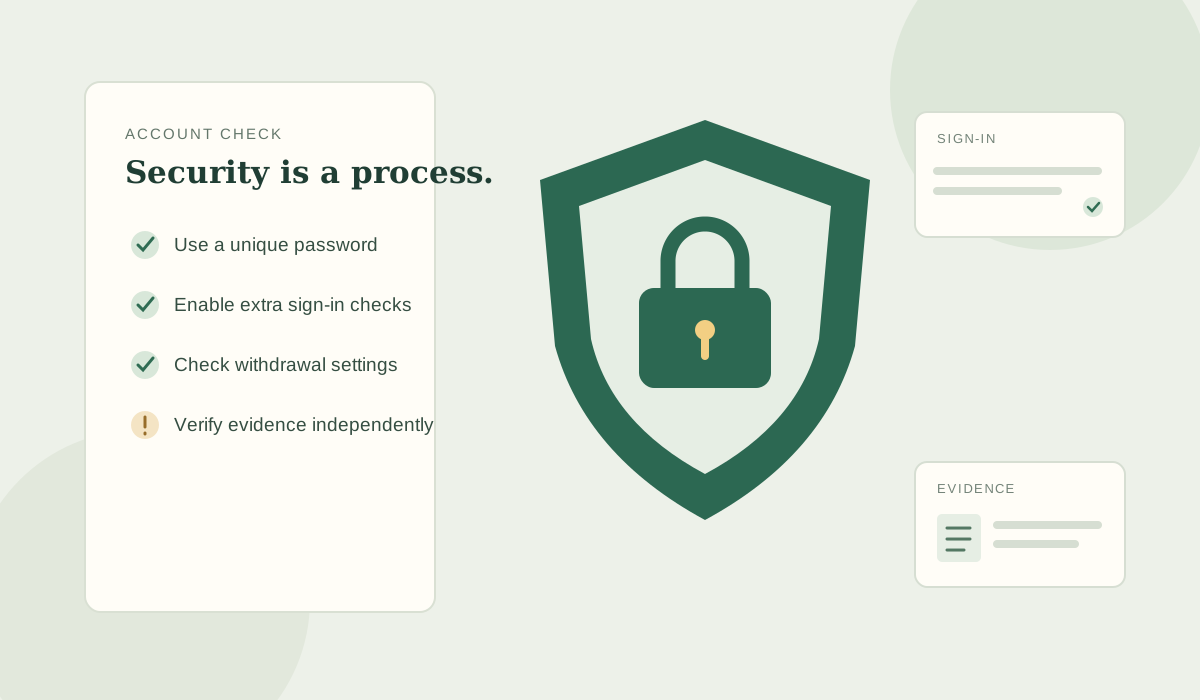
- Turn on two-factor authentication with an app, not SMS. SMS is the weakest second factor and the one most commonly defeated.
- Enable a withdrawal address whitelist. It means a stolen session cannot send funds to an address you never approved.
- Test the withdrawal path early with a small amount, before you need it.
- Keep most holdings off the platform. The exchange balance is working capital, not storage.
- Check the restricted list for your own jurisdiction before depositing anything.
Four of those five cost nothing and take under ten minutes. None of them depend on the platform being well run.
Restricted jurisdictions are listed in the User Agreement, linked on every page of this site. Read that before registering anywhere.
Open a Gate account Referral link — we may earn a commission at no extra cost to you. Gate's services are not available in every jurisdiction; check the User Agreement.Sources
- Gate User Agreement: section 2.5 (restricted locations), 2.10 (no solicitation of US persons).
- Gate risk disclosure: section 7.1 (promotions not directed at restricted locations).
- Gate account security documentation: 2FA and withdrawal whitelisting. What a regulator says to check before depositing anywhere: and .
Questions people actually ask
So is Gate safe or not?
The question does not have one answer. Whether you can withdraw is testable in a week with a small amount. Whether the company is solvent is self-reported. Whether it is legal for you is in the agreement. Whether your account stays secure is mostly about your own settings.
What does proof-of-reserves prove?
That certain assets are held. It does not prove what is owed, so it cannot establish solvency on its own. Treat it as one input rather than a verdict.
What is the single most useful safety check?
A small deposit followed by a small withdrawal in your first week. It is the cheapest evidence available and it tests the thing that actually matters when you need it.
Does two-factor authentication make my account safe?
It removes the most common attack path, not all of them. An app-based second factor plus a withdrawal whitelist covers materially more than SMS codes alone.