You open a long. Ten times leverage, $10,000 of your own money, so the position is $100,000.
The price moves 0.2% your way. You are right. You close it.
Your account is $34.70 richer.
You expected $200.
Nothing went wrong. There was no liquidation, no glitch, no hidden charge from a scam exchange. Every one of those dollars is accounted for in the fee schedule you agreed to when you signed up — a schedule almost nobody reads, and a subtraction almost nobody does beforehand.
Here is where the other $165.30 went.
Where the money went
Two numbers decide it, and they are both on the same row of the fee table.
| What you paid | Why | |
|---|---|---|
| Opening the position | $75.00 | You crossed the spread. That makes you a taker. |
| Closing it | $75.00 | Same thing, on the way out. The fee is charged twice. |
| Holding it overnight | $15.30 | Funding. Not a fee — a payment to whoever took the other side. |
| Total | $165.30 | Against $200.00 of profit. |
That third row is the one that catches people. It is not on the fee page. It is not in the app's order preview. It arrives whether you are in profit or not, three times a day, for as long as the position is open.
The same trade, placed differently
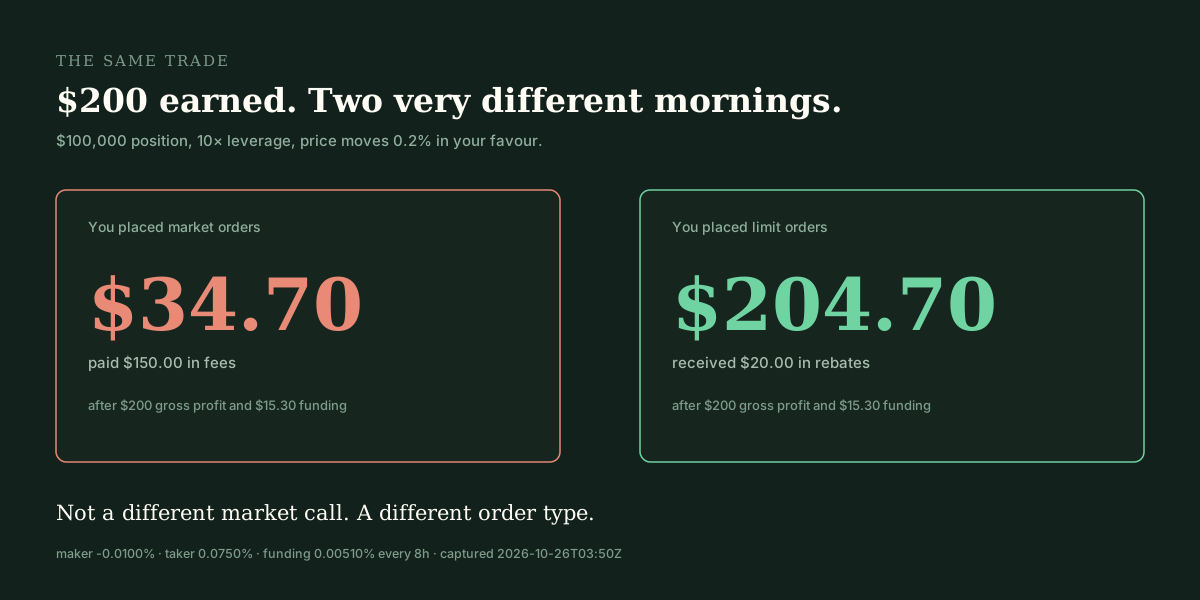
Suppose you had done nothing different about the market. Same direction, same size, same exit. You only changed how your orders reached the book: instead of clicking market, you put a limit order in and let it sit.
| Market order | Limit order | |
|---|---|---|
| Opening the position | $75.00 | −$10.00 |
| Closing it | $75.00 | −$10.00 |
| Funding, 24 hours | $15.30 | $15.30 |
| What you keep | $34.70 | $204.70 |
Your market order cost you money. Your limit order paid you.
Not a small rebate — $20.00 on a $100,000 round trip. Because when your order rests in the book, you are supplying liquidity that somebody else needs. The exchange pays for that. It is the same row of the same table, with a minus sign in front of it.
This is the thing that separates traders who understand the schedule from the ones who do not. Not knowledge about the market — knowledge about the invoice.
What happens when you do it ten times
Now the part that ends accounts.
You are day trading. You take ten of these round trips in a day. Each one is a winner: ten times you catch 0.2%.
| Per trade | Ten trades | |
|---|---|---|
| Profit from the market | $200.00 | $2,000.00 |
| Fees paid | $150.00 | $1,500.00 |
| Funding | $15.30 | $15.30 |
| Day's result | $34.70 | $484.70 |
Ten wins. One loss.
You were right every single time and you ended the day down $484.70. Not because your analysis was wrong — because the fee is charged per fill, and you generated twenty fills.
The market gave you $2,000. The venue took $1,500 of it and the funding took the rest.
The part most people get backwards
Ask a trader what they can control and they will list things that happen after the order is placed: whether to hold, when to take profit, when to cut. All of those matter. But the cost is decided before the trade exists, in three choices you make in about four seconds:
- Which order type. Market or resting. On this contract that is the difference between paying $150.00 and being paid $20.00.
- How often. Every round trip is two fills. Ten round trips is twenty.
- How big. The fee is charged on notional, not margin. Doubling leverage doubles the fee in dollars, exactly.
None of those require a view on the market. All of them are decided by you. And the first one alone — resting instead of crossing — is worth more on a $100,000 round trip than most people's entire monthly trading budget.
Check it on your own account
You do not have to take any of this on trust. It takes about two minutes:
- Open your trade history. Not the order ticket — the history.
- Look at the label on each fill. Most platforms show it: maker or taker.
- Multiply the notional value of that fill by the rate for its label.
- Compare it to the fee actually deducted. If they match, you now know exactly what your orders cost. If they do not, you are on a different tier and the base rate above was never your rate.
Whatever you find, you will find it once and remember it. That is the difference between reading about fees and knowing yours.
The rates in this piece are Gate's published figures at 2026-10-26T03:50Z. If you want to see them applied to your own account, the registration page is below.
Open a Gate account Referral link — we may earn a commission at no extra cost to you. Gate's services are not available in every jurisdiction; check the User Agreement.Sources
- Gate public REST API, BTC_USDT perpetual: maker_fee_rate, taker_fee_rate, funding_rate, funding_interval. Captured 2026-10-26T03:50Z.
- Gate fee schedule and futures fee calculation help pages. The numbers above can be re-read without an account at BTC_USDT contract endpoint — checked 2026-10-27, HTTP 200.
- Gate User Agreement section 2.5 (restricted locations) and risk disclosure section 14 (fees may change without notice).