You want to buy. You pick limit order instead of market, because someone told you limit orders are cheaper.
You set the price slightly below where it is trading. The order fills two seconds later.
The exchange charges you the taker fee anyway.
You did what you were told, and it did not work.
This is the single most misunderstood thing about trading fees, and it costs people real money every day. The label on your order ticket is not what decides your fee. The label on the fill is.
Limit and maker are not the same word
A limit order is an instruction: do not pay more than this price. A maker fill is a fact about what happened: your order was sitting in the book and someone came to you.
Most of the time a limit order does become a maker fill. But not always. If you place a limit buy above the current best ask — which people do constantly when they want in fast — it executes immediately against a resting seller. You crossed the spread. That is a taker fill, with a taker fee, even though the word “limit” is printed on your order.
What the two labels are worth in dollars
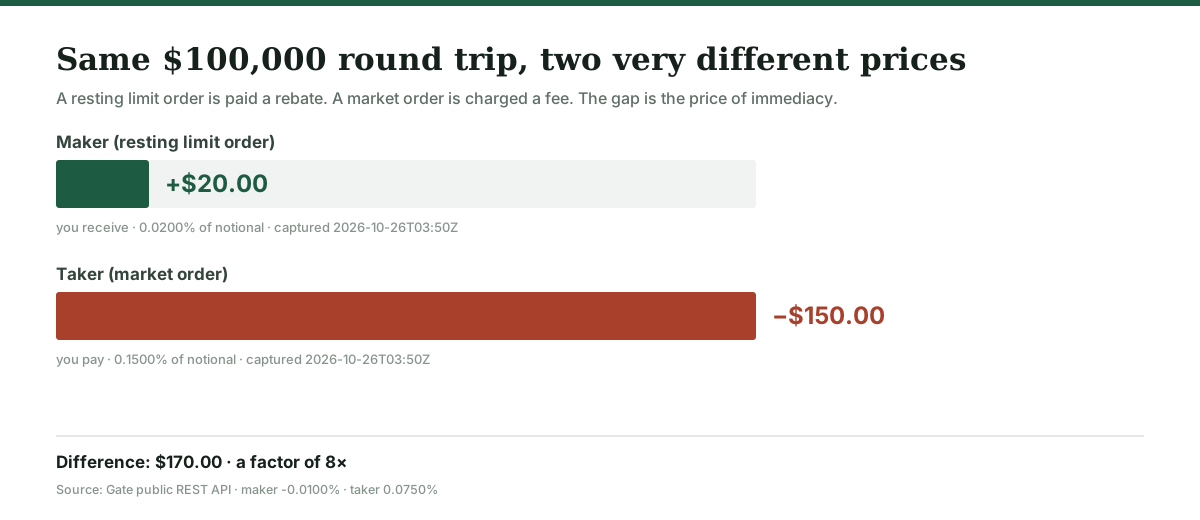
On a $100,000 position at the rates captured below, one round trip:
| Maker fill | Taker fill | |
|---|---|---|
| Opening the position | +$10.00 | $75.00 |
| Closing the position | +$10.00 | $75.00 |
| Round trip | +$20.00 | $150.00 |
That is a swing of $170.00 on one trade. Not because the market moved differently — it did not — but because of how two orders arrived at the book.
Why the exchange pays for one and charges for the other
A resting order is inventory. Somebody has to be willing to take the other side of every trade, and an exchange with no resting orders cannot function. So resting orders get paid, and impatient orders pay.
That is not a discount or a promotion. It is the price of immediacy, and it is on every exchange in some form. On this contract it is a factor of 8: −0.0100% versus 0.0750%.
Check which one you actually got
Two minutes, in your own account:
- Open your trade history, not the order ticket.
- Look at each fill. Most platforms print the classification next to the price: maker or taker.
- Compare the fee on that fill to the notional value times the rate for its label.
- If a limit order of yours was charged a taker fee, you now know why — and you know which habit to change.
Most people who do this once find at least one fill they had assumed was a maker. The number on the statement was correct all along. It was the assumption that was wrong.
Rates in this piece were captured at 2026-10-26T03:50Z. Your own tier is on the fee page inside your account, after you register.
Open a Gate account Referral link — we may earn a commission at no extra cost to you. Gate's services are not available in every jurisdiction; check the User Agreement.Sources
- Gate public REST API, BTC_USDT perpetual: maker_fee_rate, taker_fee_rate. Captured 2026-10-26T03:50Z.
- Gate fee schedule and order-type documentation. The contract endpoint mirrors the published schedule and needs no login: . A second exchange with the same split: .
- Gate User Agreement section 2.5 (restricted locations) and risk disclosure section 14 (fees may change without notice).
Questions people actually ask
Is a limit order always a maker order?
No. A limit order that crosses the spread fills immediately against a resting order, and that is a taker fill. You need the limit price to sit away from the market until someone comes to you.
Do I get the rebate if my limit order partially fills?
Each fill is classified separately. A partially filled resting order is normally maker on the portion that rested. Check the individual fill lines, not the order summary.
Why is the maker rate negative?
A negative fee is a rebate: −0.0100% means you receive $10.00 per $100,000 of filled value rather than paying it.
Can the same trade be maker on entry and taker on exit?
Yes, and this is common. Entering with a resting order and exiting with a market order is exactly that mix, and it costs $10.00 less on entry but $75.00 more on exit than a fully maker round trip.