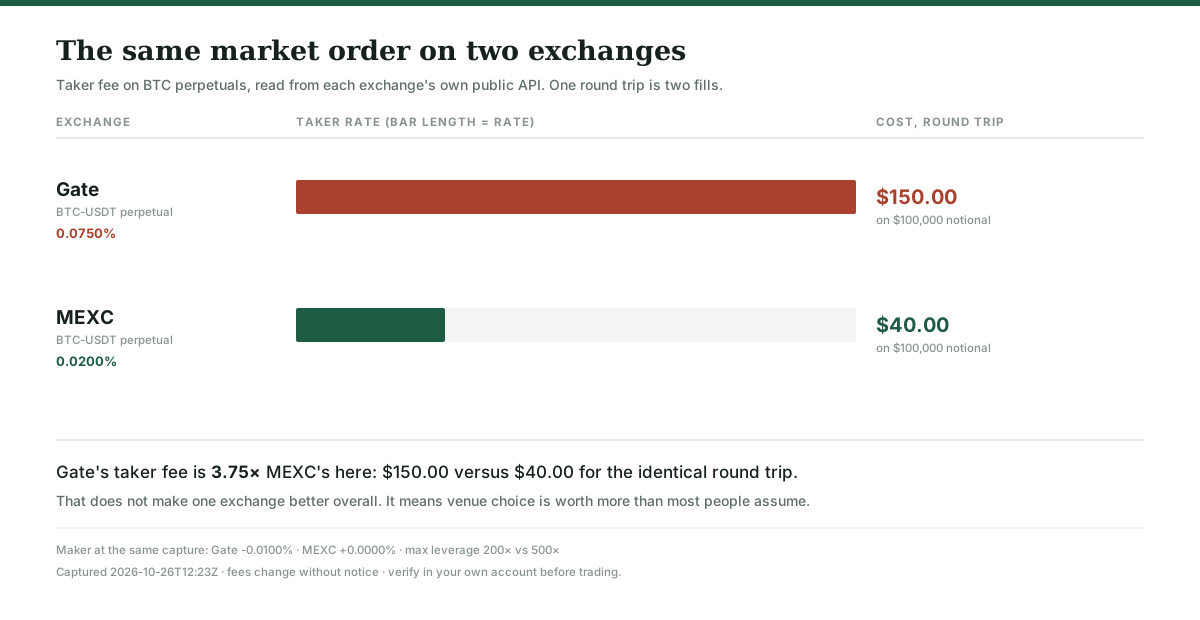
The same $100,000 market order, placed on two exchanges, sixty seconds apart.
One charges you $150.00 to get in and out.
The other charges $40.00.
The difference is $110.00 for doing nothing differently.
Both numbers were read from each exchange's own public API in the same session. Neither came from a comparison article.
The taker side, measured
| Exchange | Taker rate | $100,000 round trip | $10,000 round trip |
|---|---|---|---|
| Gate | 0.0750% | −$150.00 | −$15.00 |
| MEXC | 0.0200% | −$40.00 | −$4.00 |
Gate is 3.75× more expensive on this one line. If the comparison stopped here, the conclusion would be obvious and wrong.
Where the answer reverses
| Exchange | Maker rate | $100,000 round trip | What happens |
|---|---|---|---|
| Gate | -0.0100% | +$20.00 | You are paid to provide liquidity |
| MEXC | +0.0000% | $0.00 | Zero: neither charged nor paid |
The number neither comparison usually admits
MEXC's contract endpoint returned maker and taker rates but no funding field. Gate's returned all three.
That gap matters more than the taker difference for anyone holding positions for days. Funding is charged every 8 hours on full notional — $15.30 a day on $100,000 at Gate's captured rate. Without the equivalent number for the other platform, no holding-cost comparison is possible, and this page says so instead of estimating.
The number that looks like an advantage and is not
MEXC offers 500× on this contract; Gate offers 200×. That is a risk ceiling, not a cost. Every fee above is charged on notional, so a higher leverage limit lets you build a larger position that costs proportionally more in fees.
A bigger maximum is a capability. It is not a saving, and listing it next to fee figures invites a false comparison.
What this comparison cannot do
It covers two of six exchanges, because those are the two whose fee fields were readable without an account. Binance and Bybit blocked requests by region; OKX and KuCoin required authentication for fee data.
- No VIP-tier rates. Both figures are base rates. Your own tier may be lower on either.
- No spread or slippage. Neither is published as a rate, and on thin books either can exceed the fee.
- No funding for one side. Missing, and marked as missing rather than filled in.
- No reliability comparison. Withdrawal speed and support quality are not in any API.
A two-exchange comparison missing one funding rate is not a ranking. It is a starting point that you can verify yourself in about ten minutes by opening each fee page logged in.
These are published base rates at 2026-10-26T12:23Z. Your effective rate and eligibility are visible only inside an account.
Open a Gate account Referral link — we may earn a commission at no extra cost to you. Gate's services are not available in every jurisdiction; check the User Agreement.Sources
- Gate: api.gateio.ws/api/v4/futures/usdt/contracts/BTC_USDT — captured 2026-10-26T12:23Z.
- MEXC: contract.mexc.com detail endpoint — no login required — captured 2026-10-26T12:23Z.
- A third exchange you can check yourself: . Excluded after testing: Binance and Bybit (regional block), OKX and KuCoin (authentication required for fee data). No figures from excluded platforms appear here.
Questions people actually ask
Why are only two exchanges compared?
Those are the two whose maker and taker fields could be read from a public API without an account. Binance and Bybit blocked requests by region; OKX and KuCoin required authentication. Listing the others with guessed numbers would defeat the purpose.
So is MEXC cheaper?
For taker orders on this contract at these rates, yes — 3.75×. For maker orders the comparison reverses, because Gate pays a rebate and MEXC pays nothing. Neither answer is general.
Why is one funding rate missing?
The endpoint used returned fee rates but no funding field for that exchange. It is marked not available rather than estimated, because an estimate becomes indistinguishable from a measurement once published.
How current is this?
The capture timestamp is 2026-10-26T12:23Z and appears on the page. Treat anything more than a month old as historical rather than current.