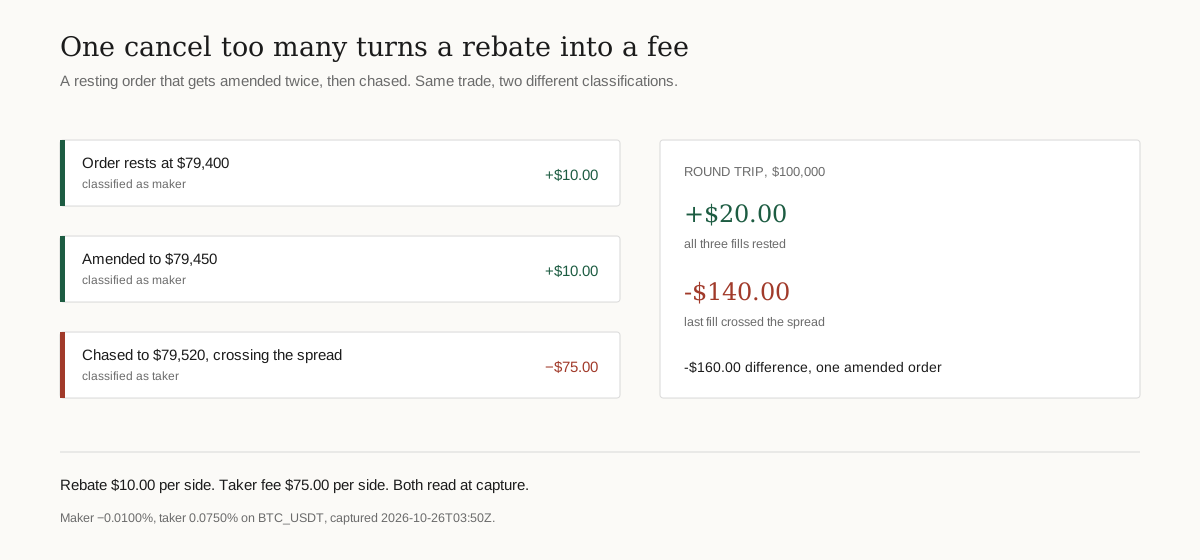
You place a limit order at $79,400. It rests. The book marks it maker.
Price drifts up. You amend the order to $79,450 to stay ahead.
It still rests. Then you chase it once more, to $79,520, and it fills instantly against a seller.
Three orders. Two rebates and a fee. The last one cost more than the first two earned, and you never changed strategy.
Maker rebates are paid for one thing: adding liquidity that someone else can trade against. The label is assigned at the moment of the fill, not when you opened the ticket. An amendment is a cancel and a new order, and a new order can arrive on the wrong side of the spread.
The label is decided at the fill
On this contract the maker rate is −0.0100% and the taker rate is 0.0750%. Both are published, both are fixed, and neither is negotiable at order time. What decides which one you pay is whether your order was resting in the book when the other side arrived.
Rest, and the platform pays you $10.00 on $100,000.00. Cross, and you pay $75.00 on the same notional. The difference is $85.00 on one fill, produced by nothing but timing.
What chasing the price actually costs
Three versions of the same intent, measured on the same notional:
| What you did | How it filled | Rate applied | Net for the $100,000 side |
|---|---|---|---|
| Rested at $79,400 | Someone sold into you | −0.0100% maker | +$10.00 |
| Amended to $79,450 | Someone sold into you | −0.0100% maker | +$10.00 |
| Chased to $79,520 | You took the offer | 0.0750% taker | −$75.00 |
The full round trip in the chart — three maker fills on one side, three on the other — nets $20.00. Replace the last fill on each side with a taker fill and it nets −$75.00. A difference of $85.00 across one amended order, for a price improvement of $150.00 on the notional.
Read those two numbers side by side. You chased $150.00 of price and it cost $85.00. The improvement was never going to cover the rate change, and the order preview said nothing about it.
The counter-intuitive part: patience is the rebate
Most explanations of maker rebates describe them as a reward for a particular order type. That gets the causality backwards. The rebate is a reward for
This is why the same ticket can be a rebate or a fee depending on the second it reaches the book, and why two traders using identical limit orders can have different effective rates with no difference in skill. The one who amended five times paid taker rates; the one who set the price and walked away did not.
The three amendments that pay for themselves
- Cancel and re-place rather than amend when the book is moving fast. An amendment into a moving book is how a resting order becomes a crossing one.
- Amend downwards on a sell, upwards on a buy — never towards the spread. Moving away from the touch keeps you resting. Moving towards it does not.
- If you must cross, cross once and completely. Two partial taker fills cost the same percentage as one, but a partial taker fill followed by a resting remainder is two different rates on one decision.
Two minutes: find your own amendment cost
- Open your trade history and filter by rate type. Most platforms show maker or taker per fill.
- Find every taker fill that started as a limit order. These are amendments, chases, or stop-limit triggers.
- Add up the notional on those fills and multiply by the difference between the two rates. On this contract that difference is 0.0850%.
- Compare that total to your rebates. If amendments cost more than rebates earn, the limit order habit is not currently paying you.
Nothing in that exercise requires a different exchange, a different strategy, or a paid tool. It requires looking at the rate column instead of the price column, which is the one column no chart shows.
Where these numbers come from
Measured: Gate contract endpoint for BTC_USDT — maker_fee_rate and taker_fee_rate, no login required
Compare: OKX published fee schedule — a second exchange where the same maker/taker split applies
Background: Investor.gov glossary: liquidity — what “adding liquidity” means in plain language
Rates above were captured at 2026-10-26T03:50Z. Your own tier appears inside an account, after registration.
Open a Gate account Referral link — we may earn a commission at no extra cost to you. Gate's services are not available in every jurisdiction; check the User Agreement.Sources
- Gate public REST API, BTC_USDT perpetual: maker_fee_rate -0.0001, taker_fee_rate 0.00075. Captured 2026-10-26T03:50Z.
- Maker/taker classification is applied at fill time by the platform; the description here follows published platform behaviour and is not a captured data field.
- Price levels in the worked example are illustrative and labelled as such. Fee and net figures are computed from the captured rates.