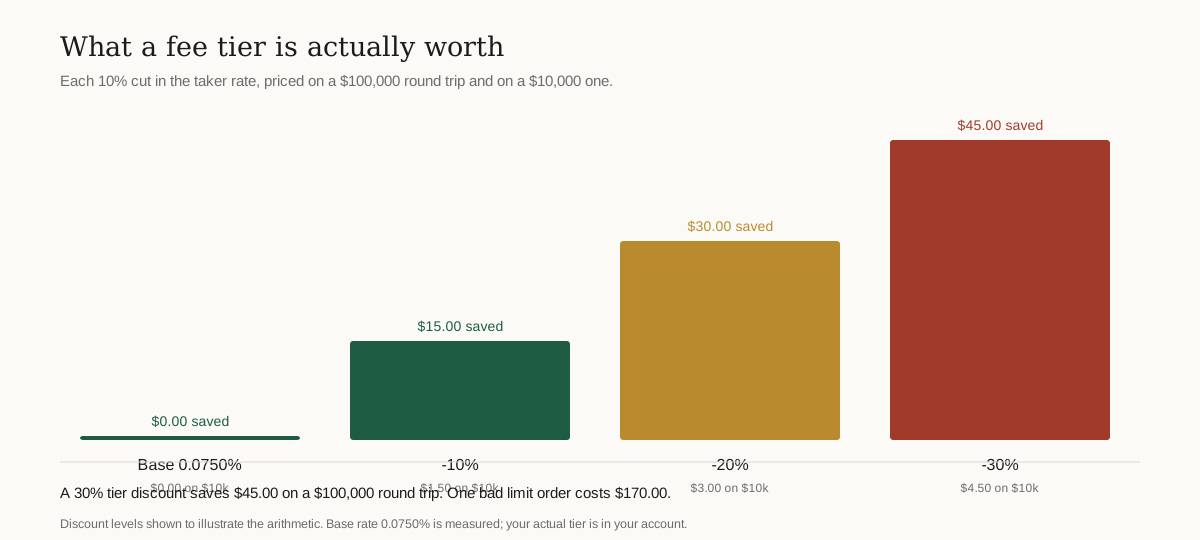
The fee page offers a tier: 10% off, then 20%, then 30%.
The percentages are printed next to each other and they look like a ladder worth climbing.
On $10,000.00 of notional, the whole ladder from base to the last rung is worth $4.50 per round trip.
Climbing it takes months of volume. Finding that number takes one multiplication.
Fee tiers are the part of an exchange that feels like progress. Volume goes up, the rate goes down, a progress bar fills. What the ladder does not show is the exchange rate between the two: how much turnover buys how many dollars, and whether the effort is worth the discount.
What each rung is actually worth
Base taker on this contract is 0.0750%. The chart shows a ladder of discounts applied to a $10,000.00 round trip, because that is a size where the numbers are readable:
| Tier | Taker rate | Round trip on $10,000 | Saved per round trip | Extra volume needed |
|---|---|---|---|---|
| Base | 0.0750% | $15.00 | $0.00 | — |
| −10% | 0.0675% | $13.50 | $1.50 | Not published |
| −20% | 0.0600% | $12.00 | $3.00 | Not published |
| −30% | 0.0525% | $10.50 | $4.50 | Not published |
The last column is deliberately empty. Tier thresholds live inside an account, differ by product, and reset on a rolling schedule; publishing a number for them here would be inventing data. The column that matters for the next decision is the fourth one, and it is fully computable.
The reverse question nobody asks
Every fee page frames tiers as a reward for volume. Turn it around and it becomes a cost statement: to earn the $4.50 discount on $10,000.00 of round trips, you have to trade enough volume to qualify. At the base rate, that volume costs 0.0750% per side every time it happens.
Which means the tier is not a discount on trading. It is a rebate paid after you have already spent more than the rebate is worth. The people the ladder genuinely rewards are those who would have traded that volume anyway — market makers, high-frequency desks, bots. For everyone else it converts an irrelevant saving into a reason to trade more.
Why the same tier means different things at different sizes
The absolute value of a tier scales with notional, so the ladder is worth almost nothing to a small account and a great deal to a large one. At the same base rate:
| Round-trip notional | Base cost | 30% tier saves | One month of funding on the same notional |
|---|---|---|---|
| $1,000.00 | $1.50 | $0.45 | $4.59 |
| $10,000.00 | $15.00 | $4.50 | $45.90 |
| $100,000.00 | $150.00 | $45.00 | $459.00 |
On $100,000.00, the full 30% tier saves $45.00 per round trip. One month of holding the same position costs $459.00 in funding. The tier is worth less than three days of carry.
Two minutes: is your tier worth chasing
- Find your current rate and the next tier's rate on the fee page inside your account. Both are percentages of notional.
- Multiply the difference by your average round-trip notional and by 2. That is what the next rung is worth per trade.
- Multiply that by how many round trips you actually make in a month. That is the monthly value of the tier.
- Compare it to the funding and slippage you absorbed last month. If the tier is the smaller number, stop optimising it.
The point of that exercise is not to conclude that tiers are worthless. At institutional size they are the difference between a viable strategy and an unviable one. The point is that the answer depends on notional and frequency, and neither of those appears on the ladder.
Where these numbers come from
Measured: Gate contract endpoint — the base rates every tier is a discount from
Compare: OKX fee schedule — a published ladder with visible thresholds
Second exchange: MEXC contract detail — taker 0.0200% base — lower than this site's base tier before any discount
Background: Investor.gov: leverage — notional is what fees are charged on, not margin
Your own tier appears on the fee page inside an account, after registration. Base rates above were captured 2026-10-26T03:50Z.
Open a Gate account Referral link — we may earn a commission at no extra cost to you. Gate's services are not available in every jurisdiction; check the User Agreement.Sources
- Gate public REST API, BTC_USDT perpetual: taker_fee_rate 0.00075, maker_fee_rate -0.0001, funding_rate 5.1e-05. Captured 2026-10-26T03:50Z.
- Tier discount percentages (10/20/30%) are illustrative, used to demonstrate the arithmetic of a discount ladder. Volume thresholds are not published on this site because they are not observable without an account.
- Funding comparison uses 90 settlements per month at the captured rate, held constant.