Type “Gate review” into a search engine and you get a score out of five.
Almost none of those scores can be reproduced. There is no method, no sample, no date.
This page will not add a sixth number to that pile.
It will show you the part that can be checked, and say plainly what cannot.
A review score is a claim about everything at once: fees, security, support, solvency, usability, withdrawal reliability. Each of those is measurable to a different degree, and some are not measurable by an outsider at all. Collapsing them into 4.2 out of 5 hides which ones the reviewer actually checked.
So this page splits the question into what can be verified and what cannot.
What can be checked from the outside
| Item | Verified value | How it was obtained |
|---|---|---|
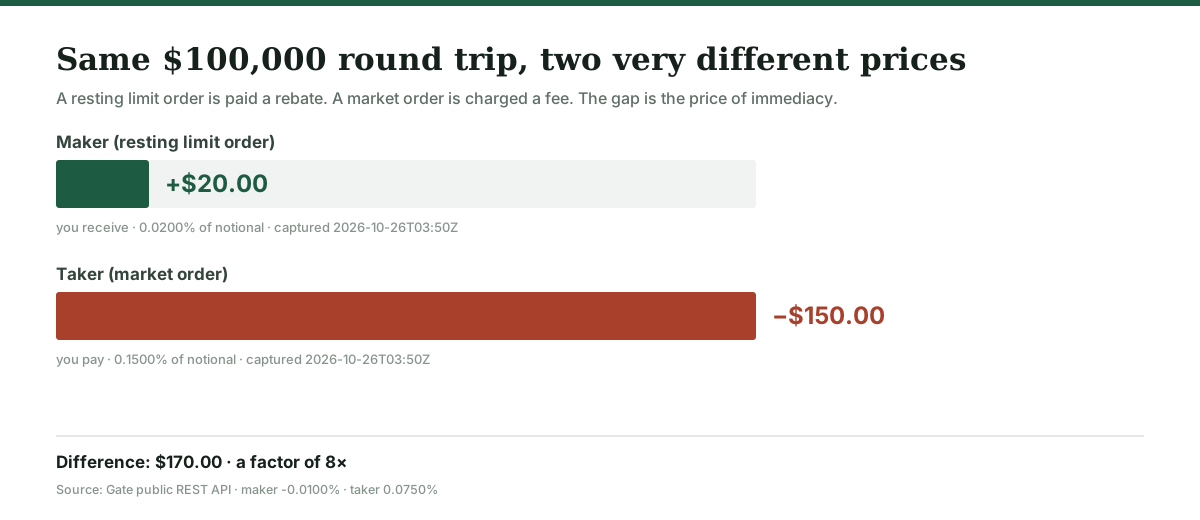
| Perpetual maker fee | −0.0100% | Public REST API |
| Perpetual taker fee | 0.0750% | Public REST API |
| Funding rate | 0.00510% every 8h | Public REST API |
| Spot fee | 0.20% | Public API (single rate) |
| Maximum leverage | 200× | Contract endpoint |
| Maintenance margin | 0.30% | Contract endpoint |
Six facts, all dated, all repeatable. This is the entire verified basis of this page.
What cannot be checked from the outside
None of the following can be established by reading an API, and all of them appear in review scores:
- Solvency. Reserves are self-reported. There is no independent audit of a crypto exchange's full balance sheet that you can perform as an outsider, and proof-of-reserves is not proof of liabilities.
- Support quality. Depends on the ticket, the day, and the language. A review that scored it either tested it once or did not test it.
- Withdrawal reliability over time. Only observable after the fact, and only at scale.
- Security practices. Whether cold storage is real, how keys are held, what happens internally on a breach — all claims, not observations.
- Regulatory standing in your own jurisdiction. Varies by where you are, and the only authoritative source is the platform's own agreement.
The one thing you can verify that matters most
Here is the part that is genuinely checkable and that almost no review covers: whether the platform is available to you at all.
Gate's User Agreement excludes users from a long list of jurisdictions, and the risk disclosure states that promotions are not directed at restricted locations. That is not a footnote — it determines whether an account you open will be usable, and it is in a document you can read before registering.
The fee table above is real and dated. It is also irrelevant if the answer to that question is no.
What this page concludes
It does not conclude. There is no score at the bottom.
What it does is give you the numbers that any honest review would have to start from, in a form you can re-run next month to see whether they still hold. If the fees change, this page changes. If they do not, that is information too.
These are the published rates at 2026-10-26T03:50Z. Your own effective rate, and whether you are eligible, is inside the account.
Open a Gate account Referral link — we may earn a commission at no extra cost to you. Gate's services are not available in every jurisdiction; check the User Agreement.Sources
- Gate public REST API: futures/usdt/contracts/BTC_USDT and spot currency pairs. Captured 2026-10-26T03:50Z. Re-run it yourself: . A second exchange on the same field names: .
- Gate User Agreement, section 2.5 (restricted locations) and 2.10 (no solicitation of US persons).
- Gate risk disclosure, section 7.1 (promotions not directed at restricted locations).
Questions people actually ask
Why won't you give Gate a rating?
Because most of what a rating claims to measure cannot be observed from outside, and averaging checkable facts with uncheckable ones produces a number that looks more reliable than its weakest input.
Is Gate safe?
That question bundles several different things. Deposits and withdrawals being reliable is observable over time; solvency is self-reported; whether it is available to you is in the User Agreement. This site can only verify the last one, and does.
Are these rates the ones I will pay?
Not necessarily. These are base rates captured at 2026-10-26T03:50Z. Volume tiers, promotions and regional differences can produce a lower rate. The authoritative figure is inside your own account.
How often are these numbers updated?
They change when the capture is re-run, and the timestamp on the page says how old they are. Anything older than a month should be treated as historical rather than current.