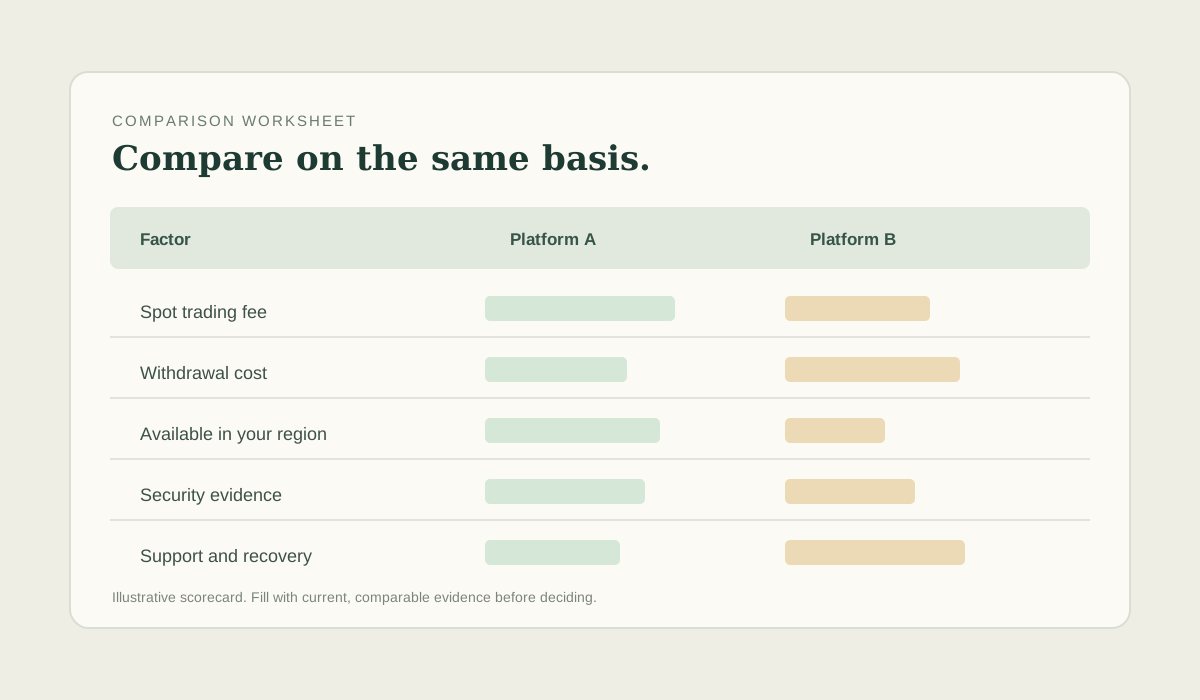
You search for the cheapest exchange.
You find four lists with four different winners.
One of them is an advertisement. You cannot tell which.
The problem is not that the lists disagree. It is that the question has no single answer.
Any list that names one exchange as “cheapest” has quietly picked an assumption about how you trade. Choose a different assumption and a different exchange wins. That is not corruption, it is arithmetic.
Why the question has no answer
A fee comparison needs three inputs before it means anything: how often you trade, how you place orders, and how much you move. Change any of them and the ranking moves. A published ranking has frozen all three at values it never states.
| If you trade like this | What dominates your cost | What to compare |
|---|---|---|
| Rarely, resting orders, holding for days | Funding | Funding rate and settlement interval, not trading fees |
| Constantly, market orders | Taker fees | Taker rate, and whether a volume tier is reachable |
| Frequently, resting orders | Maker rebate | Whether the maker rate is negative, and by how much |
| Small amounts, moving funds often | Withdrawal fees | Per-coin withdrawal fees, not percentages at all |
The two halves of a fee that lists merge
Published rate tables show percentages. What actually leaves your account is dollars, and the two only line up if the notional is the same. A 0.02% taker fee on a $100,000 position is $20 per fill. A 0.075% taker fee on a $10,000 position is $7.50. The cheaper percentage cost more money.
Leverage makes this worse, because it scales notional without scaling the capital you posted. The rate does not change; the dollars multiply.
How to actually compare, in four steps
- Pick your real notional, not the one you wish you traded. Capital × the leverage you actually use.
- Count your fills last month. Two per round trip. This is the number people estimate worst.
- Get your own rate on each platform, logged in. Base rates are marketing; tier rates are what you pay.
- Price the non-fee costs too — withdrawal fees per coin, and how long funds take to move. A cheaper trade is not cheaper if it strands your money.
How to read a comparison you did not make
Four questions separate a usable comparison from a sales page:
- Is there a date on it? Fee schedules change. An undated comparison is a claim about the past dressed as the present.
- Does it say where the numbers came from? API, official page, or “a study” with no source.
- Does it show dollars, or only percentages? Percentages hide position size.
- Does it disclose how the site earns? If it ranks one platform first and has no affiliate disclosure, the ranking is the business model.
That last one is uncomfortable for a site like this one. This site does have a referral link, which is disclosed next to every link and in full on the disclosure page. The difference is not the presence of a commercial interest — it is whether the numbers would survive you checking them.
If you want to check the numbers on this site against a live account, the registration page is below. Nothing on this page depends on you clicking it.
Open a Gate account Referral link — we may earn a commission at no extra cost to you. Gate's services are not available in every jurisdiction; check the User Agreement.Sources
- This site's own captures: Gate public API, 2026-10-26T03:50Z; MEXC public API, same session.
- Official fee schedules for each platform named above. Second exchange for the like-for-like comparison: OKX fee schedule — checked 2026-10-27, HTTP 200.
- Gate affiliate disclosure requirements, referenced in full on the disclosure page.
Questions people actually ask
Is there a cheapest exchange?
Not in general. There is a cheapest exchange for a specific trading pattern. Change the pattern and the ranking moves, which is why published rankings disagree with each other without any of them lying.
Why do percentages mislead?
Because what leaves your account is dollars. A smaller percentage on a larger notional costs more money. Leverage scales notional, so the same rate can mean very different amounts.
Should I trust a comparison with no date?
No. Fee schedules change without notice. An undated comparison is a claim about the past presented as current, and you have no way to tell how stale it is.
Does an affiliate link make a comparison unreliable?
Not by itself, but the disclosure has to be there and the numbers have to be checkable. A site that ranks its own affiliate first with no disclosure has told you what the ranking is.