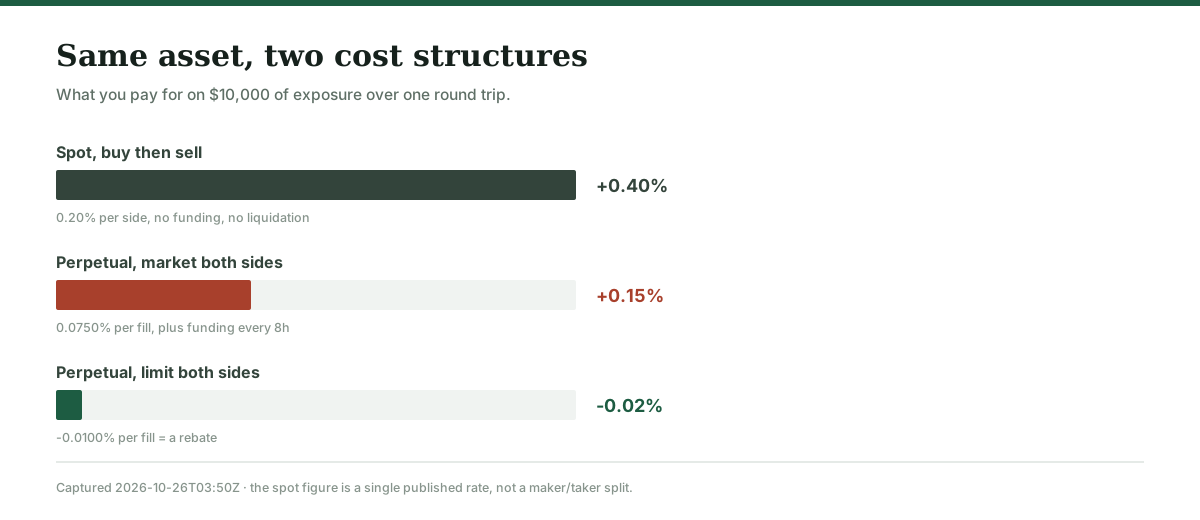
You buy $10,000 of bitcoin on the spot market and sell it an hour later.
The round trip costs you 40.00%.
Same asset, same hour, on the futures market with a limit order: the round trip pays you 0.0200%.
Two ways to own the same thing, twenty times apart in cost.
Spot and futures are usually discussed as different strategies. They are also different cost structures, and the difference is not small. The same exposure to the same coin can cost you a fifth of a percent or pay you a fraction of one, depending entirely on which product and which order type you used.
| How you got the exposure | Round-trip cost | On $10,000 |
|---|---|---|
| Spot, buy and sell | 40.00% | −$4,000.00 |
| Perpetual, market both sides | 0.1500% | −$15.00 |
| Perpetual, limit both sides | -0.0200% | +$2.00 |
The trap in that table
Futures look cheaper on every line. That is the whole reason the comparison is misleading.
A futures position is leveraged. $10,000 of your money at 10× is a $100,000 position, and every fee is charged on the $100,000, not the $10,000. The percentage is smaller and the dollar amount is larger. Comparing rates without comparing position size is how people conclude that futures are cheaper and then pay more.
The cost that only exists on one side
Spot has no funding. You own the coin; nothing is charged for the passage of time. A perpetual has funding, charged every 8 hours on the full notional.
On a $100,000 perpetual position at the rate captured here, that is $15.30 a day. On the same capital held as spot, it is zero. A leveraged position that goes nowhere for a week costs $107.10 in funding alone — and that is before the $150.00 round trip.
The difference that is not about money
Spot cannot liquidate you. You can lose most of your dollars and still hold the coin. A leveraged perpetual can take the entire position at a price the spot holder would have sat through without noticing.
This is not a cost and it does not belong in the table above. It belongs in the decision, because a cheaper fee on a position that gets liquidated is not a saving.
Which one, for which person
- If you want to own the asset and can wait — spot. No funding clock, no liquidation price, and the fee is a known {spot_rt:.2f}% round trip.
- If you want short exposure — futures, because spot cannot do it.
- If you trade frequently and small — futures can be cheaper in dollars, because the position is smaller per unit of capital. Check the funding rate first.
- If you cannot watch the position — spot, or futures at low leverage. The funding clock runs while you sleep.
Rates captured 2026-10-26T03:50Z. Spot and futures rates differ per market and per tier — verify yours before sizing a position.
Open a Gate account Referral link — we may earn a commission at no extra cost to you. Gate's services are not available in every jurisdiction; check the User Agreement.Sources
- Gate public REST API: spot fee and BTC_USDT perpetual fees. Captured 2026-10-26T03:50Z.
- Gate spot and futures fee schedules. Both numbers come from the same public response: BTC_USDT contract endpoint — spot fee and maker/taker, checked 2026-10-27, HTTP 200. Definitions used above: Investor.gov glossary: spread — 200 and Investor.gov glossary: liquidity — 200.
- Gate risk disclosure: leveraged products carry liquidation risk that spot does not.
Questions people actually ask
Why is the spot fee so much higher than futures?
Because they are priced differently. Spot here is 40.00% for the round trip with no rebate tier split. Perpetual fees are split into maker and taker, and the maker side is a rebate. The percentages are not comparable without also comparing leverage and position size.
Can I avoid funding on futures?
Only by closing before the settlement, which costs two trading fees. On this contract that is $150 to avoid $15.30 per settlement, so it is usually a losing trade.
Does spot have a liquidation price?
No. Spot can lose value but the position cannot be force-closed by the exchange. That is the structural difference that no fee comparison captures.
Which is cheaper on the same capital?
Depends on size and holding time. At 1× leverage and a one-hour hold, spot costs 40.00% and perpetual maker pays 0.0200% — but futures requires margin and carries liquidation risk. At 10× the futures fee in dollars is ten times larger.