Two exchanges out of six publish their fees in a form a machine can read.
The other four either block the request or require a login.
So a comparison covering all six is either using old numbers, guessed numbers, or numbers copied from each other.
This is the checklist that tells you which one you are reading.
Fee comparison content has a structural problem: the data is hard to get, so most of it is not fresh. That does not make every comparison dishonest. It makes it necessary to check the freshness and the sourcing before using it, because you cannot tell from the layout.
The five lines that decide your cost
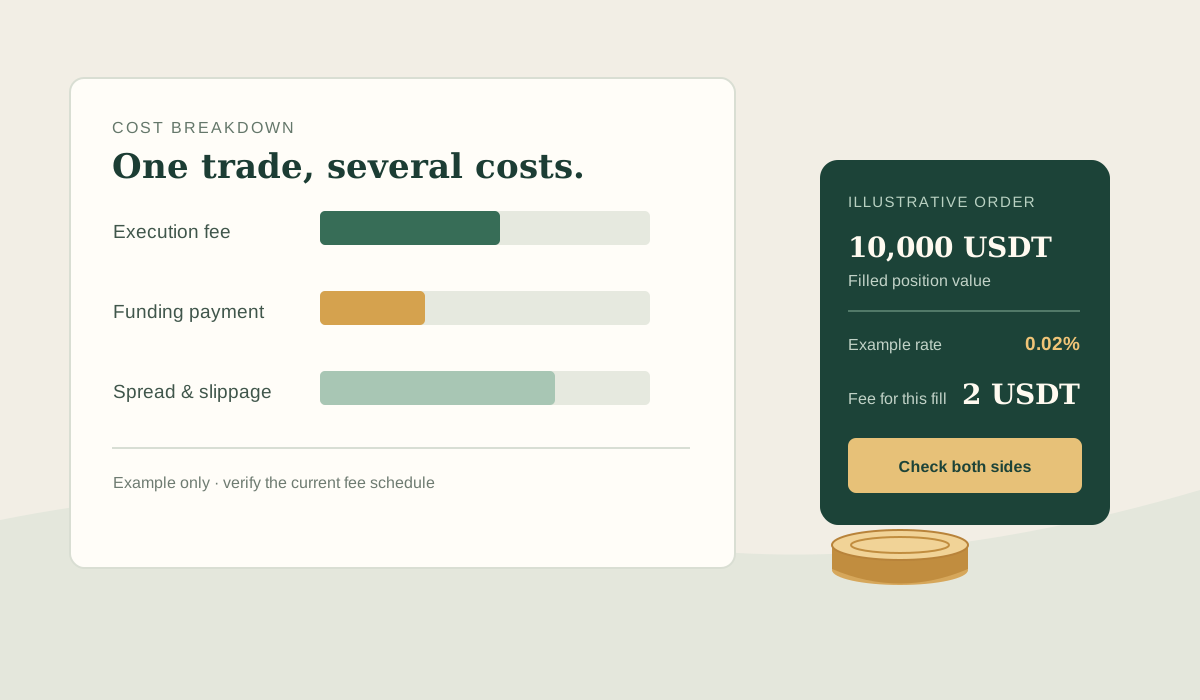
Published fee schedules show one line. Your actual cost has five, and four of them never appear on the schedule.
| Cost line | Where it appears | Typical size |
|---|---|---|
| Trading fee | Fee schedule | The only published line |
| Funding | Contract data, not the fee page | 0.00510% per 8h here |
| Spread and slippage | Nowhere — it is execution, not a fee | Varies with book depth |
| Withdrawal fee | Per coin, per network | Fixed per transfer, often the largest for small amounts |
| Deposit fee | Usually zero, sometimes not | Check per network |
The line that costs most small accounts
For anyone trading a few hundred dollars, the withdrawal fee often exceeds everything else combined. It is a fixed amount per transfer, so it does not scale down with position size.
A trader moving funds monthly pays it twelve times a year regardless of how careful their trading fees were. This is the one place where the cheapest option is not a fee optimization but simply leaving funds in place.
Check a comparison in sixty seconds
- Look for a date. No date means you cannot tell how old it is. This alone disqualifies most of what ranks.
- Look for a source. API, official page, or nothing. “According to our research” is nothing.
- Look for dollars next to percentages. Percentages alone hide position size.
- Look for the missing rows. Does it mention funding, withdrawal fees, spread? A table with only trading fees is answering a smaller question than it implies.
- Look for the disclosure. If one platform is ranked first and there is no affiliate disclosure, the ranking is the business model.
The worksheet
For your own decision, four numbers per platform, all written down on the same day:
- Your taker rate, logged in, not the base rate.
- Your maker rate, and whether it is negative.
- Funding rate and interval for the contract you actually trade.
- Withdrawal fee for the coin and network you actually use.
Four numbers, ten minutes, dated. That is a better basis for a decision than any ranking, including one on this site.
Rates and withdrawal fees are shown inside the account, per coin and per network, before any transfer is confirmed.
Open a Gate account Referral link — we may earn a commission at no extra cost to you. Gate's services are not available in every jurisdiction; check the User Agreement.Sources
- API access test across six exchanges, 2026-10-26T03:50Z: Gate and MEXC returned fee fields; Binance and Bybit blocked by region; OKX required authentication. The two that answered: Gate contract endpoint — HTTP 200, MEXC detail endpoint — HTTP 200.
- Gate public API capture, 2026-10-26T03:50Z.
- Gate fee schedule, funding documentation, and withdrawal fee page.
Questions people actually ask
Why do fee comparisons disagree with each other?
Because the data is hard to obtain and changes without notice. Some are stale, some use base rates instead of tier rates, some compare percentages across different position sizes. The disagreement is usually about inputs, not about facts.
Which fee matters most for a small account?
Usually the withdrawal fee, because it is fixed per transfer and does not scale down with position size. For someone moving funds monthly it can exceed the trading fees entirely.
Is funding part of the trading fee?
No. It is a separate periodic payment between traders, every 8 hours on this contract, charged on notional while the position is open. It does not appear on the fee schedule.
How often should I re-check my own rates?
Whenever your volume tier changes, and any time a decision depends on the number. Rates change without notice, so a figure you looked up last quarter may no longer be your rate.